

The Economics of the Porn Industry
Pornography is one of the world’s most visible forms of entertainment, yet its economics remain surprisingly difficult to measure.
Unlike Hollywood, the music business, or professional sports, there is no single global organization publishing a standardized annual report for the pornography industry. There is no equivalent of the International Federation of the Phonographic Industry for porn, and many companies are privately held.
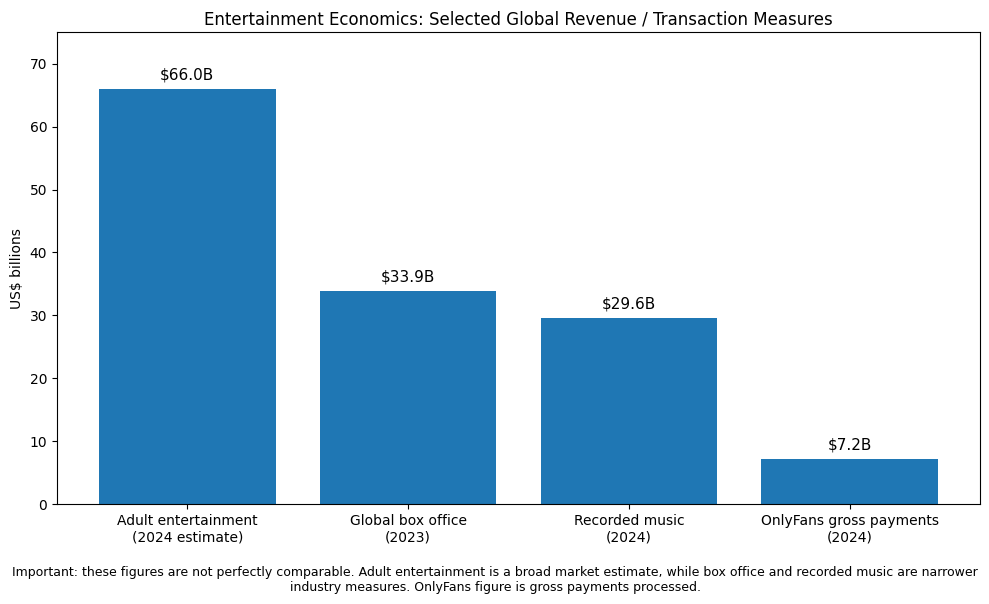
As a result, estimates of the industry’s size range enormously. Some research companies estimate the broader global adult-entertainment market at around $60–70 billion per year, while other reports produce figures several times higher because they include categories such as sex toys, strip clubs, dating, live entertainment, and other services. One 2024 estimate from The Business Research Company put the global adult-entertainment market at $65.95 billion, while ResearchAndMarkets estimated $58.8 billion in 2023.
So what is the real number?
The answer depends on what we mean by “porn.”
The First Problem: There Is No Single Porn Industry
Imagine trying to calculate the revenue of “the movie industry” while simultaneously including Netflix subscriptions, movie theaters, popcorn, television licensing, merchandise, theme parks, DVDs, streaming services, and home entertainment.
You would get an enormous number, but it would no longer be directly comparable with box-office revenue.
The same problem exists with adult entertainment.
There are traditional adult-film studios, tube websites, subscription platforms, webcam companies, independent performers, advertising networks, adult magazines, physical stores, affiliate websites, live shows and numerous other businesses.
Some market-research companies also include completely different categories such as sex toys and clubs.
That is why claims that “porn is a $100 billion industry” should be treated cautiously.
There are certainly estimates in that range, but they often refer to the broader adult-entertainment economy rather than pornography alone. Transparency Market Research, for example, has published an estimate of $287.8 billion for the global adult-entertainment market, but its definition includes online and offline entertainment, live chats and strip clubs. That figure should therefore not be interpreted as $287.8 billion spent on porn videos.
For a realistic comparison, it is more useful to concentrate on digital adult content and platforms.
How Porn Makes Money
The basic business models are surprisingly similar to those found in mainstream entertainment.
There are four major sources of money.
1. Advertising
Many adult websites provide content for free and make money through advertising.
This is particularly important for large tube-style websites. The user does not necessarily pay anything, but the website monetizes traffic through advertising, affiliate programs, subscriptions, premium offers and other commercial relationships.
The economics are based on scale.
A website receiving millions of visits can potentially generate substantial revenue even if only a tiny fraction of visitors ever spend money directly.
This is similar to YouTube, Facebook and many other internet businesses.
2. Subscriptions
Premium websites charge users a monthly or annual subscription.
The model is straightforward:
Users pay → platform keeps a percentage → creator or studio receives the remainder.
This is one of the most important developments in modern adult entertainment because it transformed porn from a studio-controlled business into a creator economy.
3. Pay-Per-View and Custom Content
Modern platforms allow performers to sell individual videos, photographs, messages, livestreams and personalized material.
This can be substantially more profitable than simply selling access to a library.
A customer who pays $10 per month might spend considerably more if they also purchase individual content or interact directly with a creator.
4. Tips and Direct Fan Payments
Platforms such as OnlyFans have demonstrated the enormous economic potential of direct relationships between creators and fans.
Instead of a traditional studio producing a film and selling it through a distributor, the performer can essentially become the studio, distributor and marketing department.
That dramatically changes the economics.
OnlyFans Is a Perfect Example
OnlyFans provides one of the clearest publicly documented examples of how much money exists in modern adult content.
According to company filings, the platform processed approximately $7.2 billion in gross payments during its 2024 financial year.
The platform itself reported roughly $1.4 billion in revenue, meaning the vast majority of the money paid by fans went to creators rather than being recognized as OnlyFans revenue. Its business model is based largely on taking a 20% cut of transactions.
This distinction is extremely important.
If someone says:
“OnlyFans made $7.2 billion.”
That is misleading if they mean the company’s own revenue.
The $7.2 billion represents the money flowing through the platform. OnlyFans’ revenue was approximately $1.4 billion.
This is the difference between gross transaction volume and company revenue.
The same distinction is essential when estimating the entire pornography industry.
And the Profit Is Even More Interesting
OnlyFans is particularly interesting because its business model is extremely scalable.
The company doesn’t have to finance thousands of expensive productions.
Creators produce most of the content themselves. Fans pay the creators. The platform processes the transactions, provides hosting, software, payment infrastructure and discovery tools, and takes its percentage.
According to financial data based on company filings, OnlyFans generated approximately $684 million in pre-tax profit in its 2024 financial year.
That means the platform itself captured a remarkably large amount of profit compared with its revenue.
This illustrates an important lesson about the modern adult industry:
The biggest money may not necessarily be in producing porn. It can be in owning the platform through which porn is bought and consumed.
Compare That With Hollywood
Now things get interesting.
Global theatrical box-office revenue was approximately $33.9 billion in 2023, according to Gower Street Analytics. Its 2024 projection was around $32.3 billion.
At first glance, that means a broad estimate of $60 billion or more for adult entertainment could suggest that porn is larger than cinema.
But this comparison isn’t perfectly fair.
Hollywood’s box-office revenue represents only ticket sales.
It does not include:
- Netflix and other streaming revenue
- television licensing
- home entertainment
- merchandise
- music
- theme parks
- advertising
- international licensing
- other intellectual-property businesses
Therefore, comparing a $60 billion estimate for all adult entertainment against a $32 billion theatrical box office is like comparing an entire entertainment ecosystem with one revenue channel.
The correct conclusion is more modest:
Adult entertainment is economically significant enough to operate on a scale comparable with major entertainment sectors, but claims that pornography is definitively “bigger than Hollywood” depend heavily on how both industries are defined.
What About Music?
Music gives us another useful benchmark.
According to the International Federation of the Phonographic Industry, global recorded-music revenue reached $29.6 billion in 2024. Streaming represented 69% of that total.
By 2025, recorded music had grown to $31.7 billion.
So a narrower estimate of the online pornography business in the tens of billions would put it in the same general economic neighborhood as the global recorded-music business.
But again, this doesn’t mean porn generates exactly as much money as music.
The music figure is based on standardized industry reporting, while pornography estimates are much less reliable.
That difference matters enormously.
The Real Revolution: Production Costs
Perhaps the most fascinating economic difference between pornography and Hollywood is the cost of production.
A major Hollywood film can require tens or hundreds of millions of dollars.
Studios spend enormous sums on:
- actors
- directors
- cinematographers
- special effects
- sets
- costumes
- locations
- post-production
- marketing
- distribution
A modern independent adult creator can potentially produce content with a smartphone, lighting equipment and a subscription platform.
That creates a dramatically different cost structure.
Suppose a creator spends $1,000 producing content and generates $10,000 in sales.
That’s a very different economic proposition from a $100 million Hollywood production that needs hundreds of millions in worldwide revenue to become highly profitable.
This doesn’t mean adult performers have easy access to huge profits. Competition is enormous, customer acquisition is difficult and income is highly concentrated among successful creators.
But the underlying production economics are extraordinarily efficient.
The Winner-Take-Most Problem
There is another similarity between pornography and mainstream digital entertainment: a relatively small number of creators capture a disproportionate share of the money.
Millions of people can upload videos, music or photographs.
Only a small percentage become major commercial successes.
Algorithms amplify this effect because popular creators receive more attention, which generates more followers, which produces more revenue, which allows them to produce more content.
This creates a feedback loop.
The same phenomenon exists on YouTube, Spotify, Instagram, TikTok and other creator platforms.
Pornography is therefore not necessarily a “get rich quick” industry for performers.
The existence of billion-dollar platforms does not mean the average creator is wealthy.
Where Does the Money Actually Go?
A dollar spent by a consumer can pass through several businesses.
For example:
Consumer → payment processor → platform → creator → agency → photographer/editor/producer → taxes
A free website has a different chain:
Visitor → advertising network → website → affiliate → merchant
A traditional studio might have another:
Consumer → retailer/platform → distributor → studio → performers and production staff
This is why “industry revenue” and “performer income” are completely different measurements.
A huge industry can exist while individual workers receive only a fraction of the money flowing through it.
So, How Big Is Porn Really?
The most honest answer is that nobody has a perfectly reliable global number for pornography alone.
Broad adult-entertainment estimates commonly land somewhere from tens of billions of dollars upward, but the definitions vary dramatically. More conservative research reports place the broader adult-entertainment market around $60 billion or more, while other estimates are much higher because they include additional adult products and services.
What we can say with much greater confidence is that individual platforms already generate enormous amounts of money.
OnlyFans alone processed around $7.2 billion in payments in 2024 and generated approximately $1.4 billion in platform revenue.
That is remarkable for a company whose core infrastructure is essentially a digital platform connecting creators and consumers.
The Real Economic Picture
The biggest misconception about pornography is that the money must be concentrated in the production of films.
Modern economics suggests something different.
The most valuable assets are increasingly traffic, audiences, platforms, payment systems, data, brands and direct relationships with consumers.
Hollywood became enormously powerful by controlling intellectual property and distribution.
The music industry became powerful by controlling catalogs and rights.
Modern adult platforms can create enormous value by controlling the relationship between creators and fans.
That is why the future of the adult industry may have less to do with giant studios and more to do with technology.
Subscription platforms, artificial intelligence, personalized recommendations, virtual reality, livestreaming, direct-to-fan commerce and independent websites are all moving the industry toward the same model that has transformed the rest of digital entertainment.
The porn industry may never have a perfectly measurable “annual revenue” figure.
But the numbers we can verify make one thing clear:
Pornography is not a small entertainment niche. It is a global digital economy worth tens of billions of dollars, with individual platforms capable of generating billions in transactions and hundreds of millions in profit.
And, just as happened with music and Hollywood, the most important question may not be how much money consumers spend.
It may be who controls the infrastructure through which that money flows.