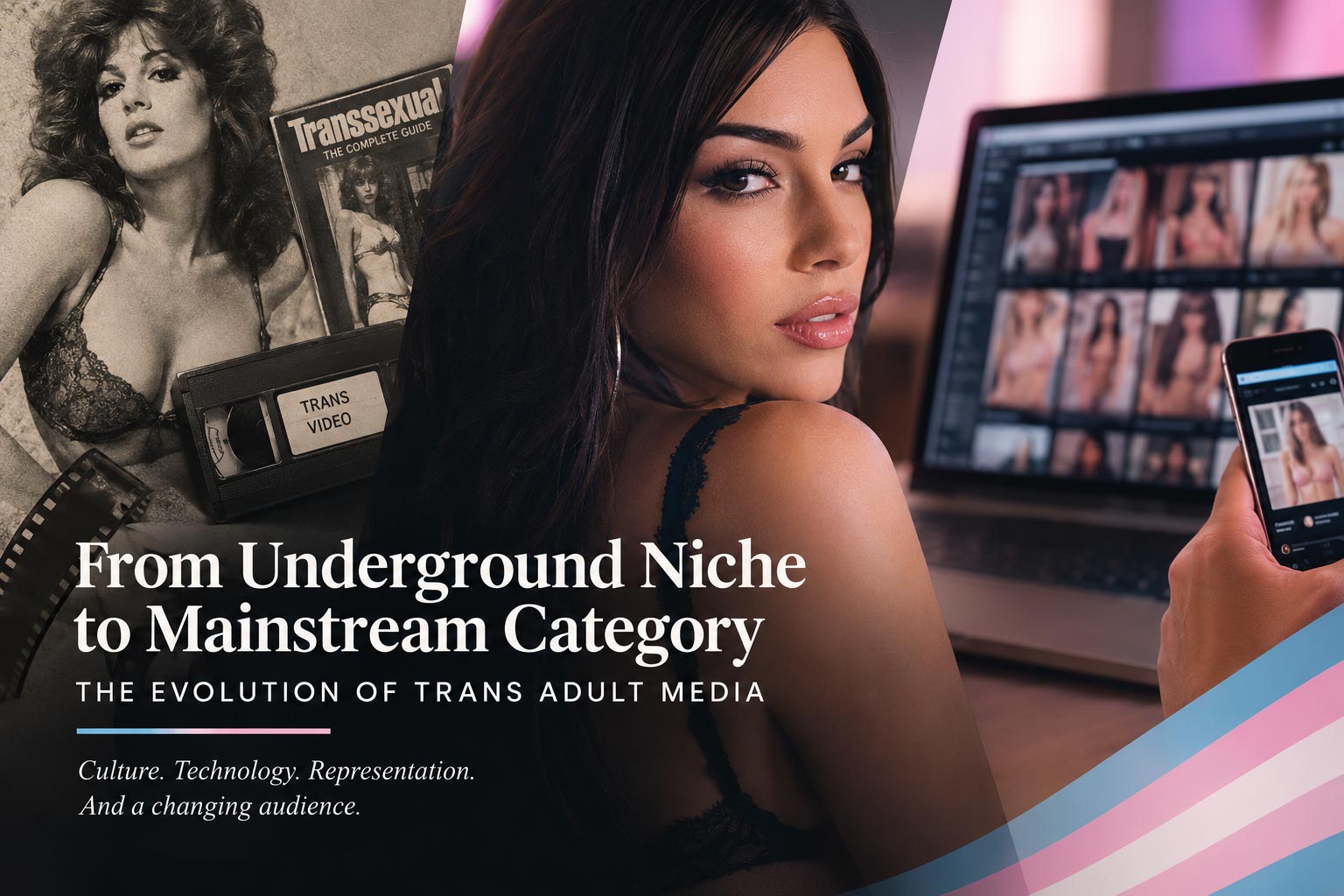
From Underground Niche to Mainstream Category: The Evolution of Trans Adult Media
For much of the twentieth century, transgender people occupied an unusual position in sexual media. They were visible, but visibility did not necessarily mean acceptance, recognition, or even accurate representation. Transgender women appeared in magazines, exploitation films, adult publications, trans escorts sites and later pornography, but they were frequently presented as curiosities, exotic figures or variations on the traditional heterosexual fantasy.
Today, the situation is considerably different. Transgender adult content has become a recognizable category within the enormous online adult entertainment market. It is produced by large studios, independent performers and subscription-based creators, and it is consumed by audiences that are considerably more diverse than the audiences traditionally associated with the genre.
How did this happen?
The answer involves several overlapping transformations: the LGBT movement, changing social attitudes toward transgender people, improvements in transgender visibility, the internet, the collapse of traditional boundaries between pornography categories, and perhaps most importantly, changes in how transgender women themselves were represented.
From curiosity to category
Transgender erotic representation did not begin with the internet.
Transfeminine people appeared in erotic magazines and other forms of sexual media decades before the emergence of commercial online pornography. Academic research has documented transgender-related adult magazines and erotic publications going back to at least the 1960s and 1970s. During this period, terms such as “transsexual,” “transvestite” and “female impersonator” were frequently used, reflecting the vocabulary of the period rather than today’s terminology.
The material was generally niche. It existed alongside other specialized forms of adult entertainment and was often marketed toward men interested in gender variance.
But there is an important historical complication: these publications were not necessarily consumed exclusively by heterosexual men.
Research into American adult magazines from the 1970s through the early 1990s has shown that some publications simultaneously served erotic, social and informational purposes for transgender readers themselves. Adult magazines could contain photographs and advertisements, but they could also provide information about gender presentation, hormones, communities and other resources at a time when mainstream institutions were often inaccessible to transgender people.
In other words, early trans adult media had two audiences.
There were people looking at it as erotic entertainment, and there were transgender people looking for representations of themselves.
That distinction becomes extremely important when discussing the later evolution of the genre.
The 1980s: video changes everything
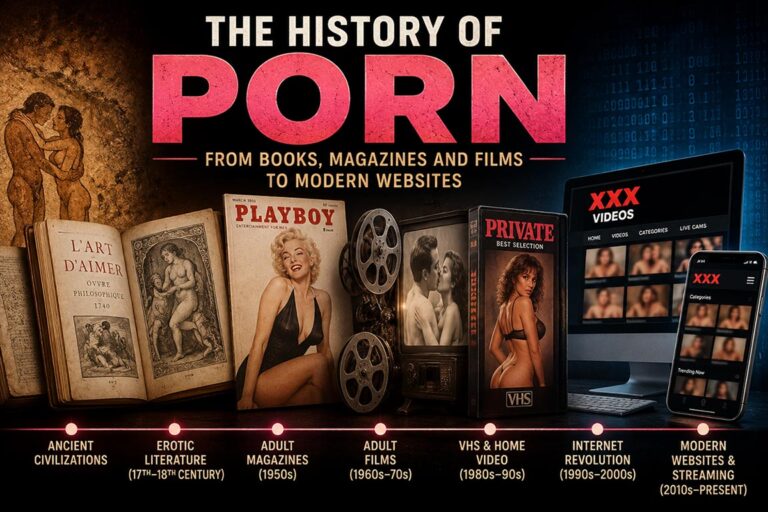
The arrival of home video transformed pornography generally.
Instead of having to visit an adult theater or purchase a magazine, consumers could privately obtain and watch adult films at home. Transgender pornography developed alongside this broader transformation.
During the 1980s, trans pornography increasingly became a recognizable commercial genre. Historical research describes the emergence of studio productions featuring transgender women, although the representations were often highly standardized: feminine appearance, exaggerated sexual characteristics and narratives constructed primarily around the presumed interests of heterosexual male consumers.
This period also established some of the visual conventions that would later become extremely important online.
The transgender woman in commercial pornography was increasingly presented not simply as a person who happened to be transgender, but as a particular combination of characteristics: conventional feminine beauty combined with a characteristic that differentiated her from cisgender women.
That formula was commercially powerful because it created a recognizable category.
At the same time, it also produced stereotypes.
The industry often favored particular body types and appearances, and many transgender performers who did not fit those conventions received considerably less visibility.
Did the LGBT movement change pornography?
Yes—but probably not in the simplistic way that is sometimes assumed.
The broader LGBT rights movement contributed to a cultural environment in which homosexuality and transgender identities could increasingly be discussed publicly rather than remaining completely hidden.
However, transgender pornography did not simply become popular because political activists persuaded heterosexual men to become interested in it.
The relationship was much more indirect.
The LGBT movement helped create greater visibility, vocabulary and cultural familiarity surrounding sexual and gender minorities. Activism also contributed to the development of communities, publications, film festivals and independent media made by LGBT and transgender people themselves.
Transgender filmmakers and artists began producing pornography and erotic media that did not necessarily follow the conventions established by heterosexual commercial pornography. By the 1990s, transgender creators were increasingly making work for transgender audiences and queer audiences as well as for conventional adult markets. Scholars describe this period as an important transformation in which trans pornography became a space for alternative representations of gender and sexuality.
This was an important cultural change.
The transgender person was increasingly becoming a subject rather than simply an object.
But there is another side to the story.
Some important developments in trans pornography came from outside queer culture altogether.
Historical scholarship has emphasized that a significant part of the genre’s development occurred within the heterosexual commercial pornography industry. Some pioneering producers and performers operated primarily within conventional heterosexual markets rather than within explicitly LGBT cultural movements.
Therefore, it would be misleading to describe the history as a simple progression from LGBT activism to mainstream pornography.
The reality was more like two currents eventually converging.
One came from transgender and queer communities.
The other came from commercial heterosexual pornography.
The internet breaks down the walls
If the LGBT movement changed the cultural environment, the internet changed the economics.
This may have been the single biggest transformation.
Traditional pornography required distribution. A magazine had to be printed. A VHS cassette had to be manufactured. A film had to be distributed through specialized businesses.
The internet eliminated much of that infrastructure.
Suddenly, a very specific sexual interest could support its own audience without requiring a massive mainstream market.
This was particularly important for transgender pornography.
Instead of being hidden somewhere inside an adult magazine or represented by a handful of performers, trans content could become an identifiable search category.
The consumer no longer needed to know the name of a particular magazine or studio. He could simply search for what interested him.
This fundamentally changed the relationship between consumers and categories.
And later, tube sites and recommendation algorithms went one step further.
Users were no longer limited to the categories they already knew. Platforms could introduce them to adjacent categories automatically.
Someone searching for conventional heterosexual pornography could encounter transgender performers without consciously deciding to enter a separate cultural world.
Academic researchers have described this transformation as the movement of trans pornography from a small niche toward an increasingly mainstream component of commercial straight pornography.
Did increasingly feminine trans women attract heterosexual men?
This is probably one of the most interesting questions.
There is a reasonable argument that the answer is partly yes, although it is difficult to establish a simple cause-and-effect relationship.
The visual presentation of transgender women changed considerably over time.
Early representations frequently emphasized the fact that the person was transgender. The difference itself was often the selling point.
Later, commercial pornography increasingly presented trans women using many of the visual conventions traditionally associated with mainstream heterosexual pornography: conventional feminine beauty, makeup, hairstyles, clothing, body proportions, photography and sexual presentation.
The result was a fascinating paradox.
The performer could be marketed as transgender while simultaneously appearing extremely close to conventional heterosexual ideals of female attractiveness.
This potentially changed the psychological barrier for some heterosexual male viewers.
A man who would never have searched for “transgender pornography” in the 1980s might encounter an attractive trans woman through an internet recommendation or mainstream adult platform and perceive the content primarily through the familiar visual language of heterosexual pornography.
The novelty was no longer necessarily “gender ambiguity.”
It could instead be presented as female attractiveness combined with a difference that was treated as an additional characteristic.
This distinction matters.
Research on contemporary sex-tech and transgender pornography notes that heterosexual cisgender men constitute an important consumer group for pornography featuring trans women. The literature also describes the recurring commercial emphasis on highly feminine presentation combined with anatomy that distinguishes trans women from cisgender women.
But we should be careful about interpreting this.
There is no solid evidence that simply making transgender women look more feminine caused heterosexual men as a population to become interested in transgender pornography.
Consumer motivations are much more complicated.
Some men may be attracted to femininity. Others may be interested specifically in transgender bodies. Others may be curious, experimental or attracted to particular performers rather than to a category. And some consumers may not attach any particular identity label to their attraction.
Pornography consumption does not necessarily map neatly onto sexual identity.
Pornography may also have changed perceptions
There is evidence suggesting that pornography and attitudes toward transgender people can influence each other, although the effect should not be exaggerated.
One study of viewers of pornography featuring transgender performers found a statistically significant but relatively weak association between greater pornography consumption and more positive attitudes toward transgender people. The researchers also found that shame surrounding attraction to transgender people was associated with greater prejudice.
This does not prove that pornography makes people more accepting.
It could work in the opposite direction: people who are already more accepting may simply be more comfortable watching transgender performers.
Nevertheless, the finding is interesting because it challenges the assumption that pornography necessarily reinforces social prejudice.
Sometimes exposure can normalize what previously seemed unfamiliar.
At the same time, pornography can also reduce a person to a sexual category. Transgender scholars have repeatedly pointed out that representation can be simultaneously visible and stereotypical.
Visibility is not automatically the same thing as understanding.
From “transsexual” to “trans”
Language changed along with the industry.
The vocabulary used in older adult media often reflected the terminology and prejudices of its time. Modern platforms generally use “trans” or “transgender,” although older terminology remains embedded in the history and commercial vocabulary of the industry.
This linguistic transformation is not merely cosmetic.
It reflects a larger shift from thinking about transgender people primarily as medical or sexual curiosities toward understanding them as a social group with identities, communities and individual experiences.
At the same time, commercial pornography has frequently retained older fantasies beneath newer terminology.
The modern label may be more socially acceptable while the underlying fantasy remains fundamentally similar.
That is one reason the history of trans pornography cannot be separated completely from the history of heterosexual pornography itself.
The modern era: performers become brands
The latest transformation is the move from studio pornography toward independent creators.
Webcams, subscription platforms and social media have allowed performers to control more of their own production and distribution.
This has changed the narrative again.
The performer can now construct an identity rather than simply appearing as a character in a studio’s fantasy.
For some trans creators, erotic content becomes part of a broader personal brand involving lifestyle, beauty, transition, fashion, humor or social media.
That represents a major departure from earlier pornography.
The transgender performer is no longer necessarily presented as an anonymous “type.”
She can be a recognizable personality.
This does not eliminate fetishization, but it gives performers greater control over how they are represented.
So what really caused the transformation?
There probably wasn’t one cause.
The evolution of trans adult media was produced by several forces acting simultaneously.
The LGBT movement contributed visibility, political legitimacy, community infrastructure and alternative forms of representation.
Transgender activists and creators helped produce images of transgender people that existed outside purely heterosexual commercial fantasies.
The heterosexual pornography industry discovered that transgender performers could appeal to a much larger market than the older niche model suggested.
The internet eliminated many distribution barriers and made extremely specific interests searchable.
Recommendation algorithms exposed consumers to categories they might never have deliberately searched for.
And changing representations of trans women made the category increasingly compatible with the visual language of mainstream heterosexual pornography.
The result was not simply the “acceptance of transgender sexuality.”
It was the convergence of culture, technology and commerce.
A final paradox
Perhaps the most interesting feature of this history is its central paradox.
Transgender pornography became more mainstream partly because transgender people became more culturally visible.
But it also became mainstream because the commercial industry learned how to present transgender women within an already familiar heterosexual visual framework.
In that sense, the history is neither purely a story of LGBT liberation nor purely a story of pornography becoming more commercial.
It is both.
The transgender woman moved from being a marginal curiosity to becoming a recognizable sexual subject, performer, celebrity and independent creator. At the same time, the industry learned that transgender identity could coexist with conventional ideas of feminine attractiveness rather than necessarily challenging them.
That may help explain why the category could expand into audiences that had previously considered themselves exclusively heterosexual.
The crucial distinction is between sexual identity and sexual curiosity.
A heterosexual man can encounter, enjoy or even repeatedly seek out transgender pornography without necessarily redefining his entire sexual identity. Conversely, a man’s interest in transgender women does not automatically tell us whether he is attracted to transgender identity itself, femininity, particular physical characteristics, or some combination of these.
The evolution of trans adult media therefore tells us something larger about modern sexuality.
The internet did not simply give people more pornography.
It gave people more precise ways of discovering what already interested them—and sometimes of discovering interests they had never previously had a name for.
That may ultimately be one of the most important changes in the history of adult media: the movement from sexuality being organized primarily by social categories toward sexuality being organized increasingly by individual curiosity, visual preference and personal discovery.